Showing posts with label France. Show all posts

Wednesday, February 13, 2019

Syrah A.K.A. Shiraz: The Experience WINE CLASS

The Northern Rhône runs along the steep slopes of the gorge from Vienne to just south of Valence


We continue our series of sessions with the Fredericksburg Tasting Room team we are calling "The Experience Wine Class." We will be watching and meeting for the purpose of expanding our knowledge and experience with wine. Our guide will be Jancis Robinson's Wine Course, an excellent resource! Aired in the United Kingdom in 1995 and is fascinating to see both areas where the wine industry has NOT changed and areas where it HAS. You can watch it all on YouTube!
Episode 5- Syrah A.K.A. Shiraz is a example where we can see a change in the wine world; in the mid-late nineties Syrah was a darling variety, many of us expected to see it explode in sales. Myself included and we can see the anticipation in the faces of the Syrah growers and vintners. Only that sales explosion never happened, and today many wine drinkers still think of Syrah as one of the "other reds" and not as one of the greatest wine grapes in the world. Jancis and the personalities she introduces to us will show us otherwise...

Jancis has shown us in episode 1 through 3; where the New World and Old World are different; climate, geology, and techniques. She has also shown us the commonality of the monumental struggle to overcome the unique challenges each region and each producer faces. Episode 4- Sauvignon Blanc added another layer of complexity as Mrs. Robinson showed us the dynamic and bold people who made the world's most famous examples of the wine; their personalities mirror the "savage" characteristics of the grape! All this foundation comes together is this show about our beloved Syrah! Here we will see the how two men in very different parts of the world use the same grape to bring their communities together and make them prosperous at the same time, in such a way that it has a positive effects in very livelihoods of everyone in the community... amazing events!

We start out in the Northern Rhone Valley, in France, as we hear about the sinister side of success; in this case attracting an armed gang that attacked the home Marcel Guigal of E. Guigal fame. As the information is filled in we find out that in addition to threats Monsieur Guigal has received other offers/demands for his wine; including blank checks, Ferraris and women! As the tour continues we see the cave where the barrels of aging wine are lined up in a peaceful setting they call "The Cathedral to Wine." In bright contrast doors open to the mechanized and computerized receiving lines, two of them in case one fails, where there is a buzz of activity as growers are bringing their crops in to sell to Marcel. We are shown how tough and detail oriented he can be and we can see how his success supports this thriving farm community and how the community supports the Guigals and the dynamic tension this relationship creates.

As an intermission to the drama we visit California with Jancis... Fred Cline, of Cline Cellars, has a vineyard gold mine in the Oakland area where the sandy soil has some of the oldest Mourvèdre vines in California, planted by the European immigrant farmers. Next we meet Doug Danielak who has a bad case of Syrah fever as he shows Jancis the Paras Vineyard where the famous Jade Mountain Syrahs once came from, alas the brand was sold off and lost it's former glory. The wine was made by Doug under the Paras Vineyard label. It was incredible! Tragically; in 2017 wildfires burned up the vineyards! In this video standing in the Paras Vineyard Doug says “Syrah is one of the world’s greatest grapes!”

"In California Syrah was an ultra fashionable rarity in and in Australia it grew like a weed..." Jancis explains as she gives us the brief history of the Barossa Valley which was settled by Lutherans fleeing Germany's turmoil of the time. Their hard work build this community and transformed it into a little bit of Germany in Australia. (Does this sound familiar to anyone in Fredericksburg, Texas?) In the 1970’s the big wine business came to the Barossa, the Accountants had full control. The accountants had worked out the cost of making wine and when a glut of grapes came along in 1979 the big business did not honor their contracts and refused to buy ANY grapes from the BarossaValley. In steps Peter Lehmann, son of a Lutheran pastor, built a local winery on the fly and bought the Valley’s entire production for the vintage; saving many of the local farmers from financial ruin. Affectionately his peers nicknamed him the “Bishop of Barossa.” He rules from the "weighbridge" at his winery where the growers bring him their grapes to buy. Here too his support of the community and the communities support of Peter is the only way all of them were able to find success. You can see the growers gratitude and appreciation of Peter in their faces. There is a very genuine, honest and sincere atmosphere here at the weighbridge, it has a comfortable and friendly feeling. Mr. Lehmann also says; “Shiraz is one of the world’s greatest grapes.”

So, the same way the dynamic personalities said a lot about the wines in episode four; similarly these generous, supporting and driven men who make some of the world's greatest Syrah also mirror the wine they make. I have not had any other wine as frequently and I can not find another wine that delivers so much complexity and flavor at all price points. For ME; Syrah A.K.A. Shiraz IS the world's greatest grape variety!!!

If you will read this handout which has a few notes from the video and a lot of information and links to more on the web related to the topics Jancis covers, hopefully it adds to the subjects and fills you in on where the personalities from the video are today. It is my sincere hope that you are finding this blog informative and instructional.

Wednesday, February 6, 2019

Sauvignon Blanc: The Experience WINE CLASS

"The Wildman of Pouilly" Didier Dagueneau, 1956-2008
“Nothing as refreshing!”
- Jancis Robinson

We continue our series of sessions with the Fredericksburg Tasting Room team we are calling "The Experience Wine Class." We will be watching and meeting for the purpose of expanding our knowledge and experience with wine. Our guide will be Jancis Robinson's Wine Course, an excellent resource! Aired in the United Kingdom in 1995 and is fascinating to see both areas where the wine industry has NOT changed and areas where it HAS. You can watch it all on YouTube!

Episode 4- Sauvignon Blanc continues the juxtaposition Jancis showed us in episode 2 and 3; New World vs Old World. AND the commonality of the monumental struggle to overcome the unique challenges each region and each producer has as Jancis shows us in Episode 3- Cabernet Sauvignon. In Episode 4 the layer of the owner/winemaker's personality is added in dramatic fashion; beginning in New Zealand where John Stichbury’s Vineyard is being threatened by frost so he calls in a helicopter to fly over vineyards and push warm air down on vines. As we learn more about this vineyard and winery we also see that this man is quite a character, very dynamic and bold. Mrs. Robinson goes on to introduce us to David Hoehnen who recounts how he started the Cloudy Bay winery in 1985 from nothing to being one of the most prized and recognized wines in the world. I do not know of a more bold and dramatic happening in the world of wine in our lifetime. Mrs. Robinson then whisks us, the viewers, away to France's Loire Valley where she introduces us to "The Wildman of Pouilly," Didier Dagueneau, a loner, a fighter, adventurer who was dis-owned by his Father, and died much too young. His philosophy about wine is very well thought out and expressed; “I make wine to give people pleasure. I sell happiness. It’s a good job to be in. I want wine to be a good moment in people’s lives. It’s like good food, beautiful music; it is like a beautiful painting. I think that wine should be considered as art, in the same way as painting or music.” Amen, Monsieur Dagueneau!!!

Continuing the bold and fresh personality tour, Jancis introduces us to a flying wine maker; Jacques Lurton. He is the son of established Sauvignon maker Andre Lurton of Chateau Bonnet, Bordeaux, France. Jancis explains how Jacques became the successful globe trotting wine maker he is because he did not or could not stay in Bordeaux and become competition for his Father. In his interview Jacques then explains how he works by coming into the client's winery and completely taking over, a very bold and audacious practice.

In this episode focused on the Sauvignon Blanc grape; we should not be surprised that the people who make the best examples are themselves bold and dynamic, like the grape variety. The grape gets its name from the French word "sauvage" (wild) and "blanc" (white) due to its characteristics in the vineyards and in the glass! So, is it art imitating life or is it life imitating art? Through the lives of these winemakers we can see a glimpse of how profound, magical and mysterious is the nature of wine!

It is a poignant and moving episode which is informative and instructional. Our group watched it and I provided this handout which has a few notes from the video and some information and links to more on the web related to the topics Jancis covers, hopefully it adds a bit of depth on the subjects. I tried to include links to 'where are they today' information about the people in the video.

And please reply to this blog; is Sauvignon Blanc your favorite wine?

Wednesday, January 30, 2019

Cabernet Sauvignon; The Experience WINE CLASS

Bordeaux renewed: Château Faugères’s "new" winery by Mario Botta, still looks cutting edge 10 years later!

“Cabernet Sauvignon
is special among wine grapes…”
- Jancis Robinson

We continue our series of sessions with the Fredericksburg Tasting Room team we are calling "The Experience Wine Class." We will be watching and meeting for the purpose of expanding our knowledge and experience with wine. Our guide will be Jancis Robinson's Wine Course, an excellent resource! Aired in the United Kingdom in 1995 and is fascinating to see both areas where the wine industry has NOT changed and areas where it HAS. You can watch it all on YouTube!

Episode 3- Cabernet Sauvignon continues the juxtaposition Jancis showed us in episode 2; New World vs Old World. This time Mrs. Robinson starts us in southwest France, Bordeaux, the Medoc, where dozens of people working feverishly in preparation for the Fete de la Fleur Celebration and things are about to get wet; soaking WET. All this activity is in the Saint Estephe region at the "NEW" Château LiLian Ladouys; owners Lilian and Christian Thieblot are hosting this party as a way to enter this very exclusive Bordelaise society! You can see their stress, the great effort and expense all to get noticed and accepted; to re-establish a once successful château. Jancis goes on to interview Anthony Barton owner of Leoville Barton (Second Growth in the St Julien region of the Medoc.) He is friendly and open about the Primer Crus being a “clique of their own.” “they use no vulgar advertising.” And he cautions that among the invitees “people are inclined to find fault.” He seems sympathetic to the impossible task the Thieblots have undertaken. I image this is not the first time he has witnessed this drama unfold, nor the last.

Jancis takes us thousands of miles away for the contrasting New World region; Chile. Here it is DRY, and there are no Classified Growths or hurdles to jump to gain entry to a clique. Here she shows us dusty trails and horseback riders along with some careless vineyard practices. As Jancis is interviewing Gaetane Carron, winemaker for Concha y Toro at the time, there are quick cuts to scenes of grape pickers tossing grapes around the vine rows and even a forklift dumping an entire bin of grapes on the ground! All the while Gaetane is explaining her efforts toward better viticulture management. “We have not refined our viticulture practices…” Gaetane says, and you get to see the weight of the impossible task on her shoulders as she talks.

Mrs. Robinson covers several important topics on this video including; phylloxera, why Cabernet Sauvignon is such a great grape, the nuances and nonsense in the Bordeaux wine business while showing the unraveling of the Fete de la Fleur "Garden Party" at Château LiLian Ladouys under torrential rain. As good as the contrast between the two regions is, like Jancis shows us in Episode 2- Chardonnay with Australia and Burgundy, this time the big reveal is that BOTH REGIONS AND WINERIES ARE THE SAME! ...They both have a monumental struggle to overcome the unique challenges of their region. AND, this is true of every region and every winery in the world!

It is a very exciting and dynamic episode which is informative and instructional. Our group watched it and I provided this handout which has a few notes from the video and some information and links to more on the web related to the topics Jancis covers, hopefully it adds a bit of depth on the subjects. I tried to include links to 'where are they today' information about the people in the video and I offer this link to a must read PDF about Bordeaux ten years ago; still cutting edge today!! "Extreme Estates!!!"

And please reply to this blog; is Cabernet Sauvignon your favorite wine?

Wednesday, January 23, 2019

Chardonnay; The Experience WINE CLASS

California's San Bernabe Vineyard; 9,400 acres in vines! Think of it this way: if San Bernabe were laid over the Texas Hill country, it would stretch from the Marktplatz in Fredericksburg to Hye Texas’ post office/general store. Nothing but vines all the way!!! WOW!
“It’s weird that everyone is
crazy about Chardonnay.” 
“it is such a neutral grape variety,
yet it is the world's
favorite wine!”
- Jancis Robinson
We continue our series of sessions with the Fredericksburg Tasting Room team we are calling "The Experience Wine Class."  We will be watching and meeting for the purpose of expanding our knowledge and experience with wine.  Our guide will be Jancis Robinson's Wine Course, an excellent resource!  Aired in the United Kingdom in 1995 and is fascinating to see both areas where the wine industry has NOT changed and areas where it HAS. You can watch it all on YouTube!

Episode 2- Chardonnay is AMAZING because of the juxtaposition Jancis shows us; New World vs Old World. She starts out on the Geoff Merrill's winery in McLaren Vale Australia where it is DRY as a bone and there seems to be two maybe three men working with giant machines, pumps, giant hoses, tractors and using additives like enzymes, yeast nutrients and liquid sulfur (to prevent oxidization), and techniques like all MOG removed (Martial Other than Grapes), and cooled like crazy (REFRIGERATION is very important to modern wine making), juice is squeezed as gently as possible to avoid any harsh flavors in the skins, stems and seeds.  Then Mrs. Robinson takes us to France, Meursault specifically, the vineyards and winery of  Dominique Lafon where it is soaking WET and there are DOZENS of people working, a lot of it by hand, some machines, pumps, hoses, tractors are used however only natural yeast and no additives are used. The two wineries are a night and day comparison in every way except one; both wine makers DID NOT like the other's Chardonnay AT ALL! It is GREAT television! Still and watching it again after multiple viewings!!

Jancis returns to Australia driving home even further the point of how dry it is there and interviewing  Adam Wynn of Mountadam in the Barossa Valley. He went to Bordeaux University, worked in Burgundy and had some of the most critical things to say about the French. “They have everything in their favor in France.”  “If you are born lucky enough to inherit three hectares of Meursault; it is a license to print money.”  “It is a tragedy to taste a bad French wine.”  AND the punch line to it all is that Monntadam was founded by Adam's father in 1972 as one of Australia's pioneer Chardonnay producers and handed it all over to Adam who sold off in 2002 and is seemingly out of the wine business and living in Japan!(?). While the other two Mr. Merrill and Mr. Lafon are both passionately making GREAT wines to this very day!!!  

As important to Chardonnay as anything else is the time it spends in oak barrels, so Mrs. Robinson takes us to the Francois Freres cooperage in the Saint-Romain Forests where a 150 year old tree is cut down to make two barrels!  On a whirlwind the way only a DVD can be Jancis takes us to San Francisco where the cooperage has an office and where Chardonnay DOMINATES on restaurant wine lists where she makes the declarative quote listed above.

It is a very compelling episode which is informative and instructional. Our team watched it and I provided this handout which has a few notes from the video and some information and links to more on the web related to the topics Jancis covers, hopefully it adds a bit of depth with some updates on the subjects. It is amazing stuff!!!


Please reply to this blog; is Chardonnay your  favorite wine? If so; why? 

Friday, December 22, 2017

Grower Champagne: BENOÎT LAHAYE

When it's time to celebrate good times; we reach for Champagne!!! I recommend that you not only seek out TRUE Champagne that represents only eighteen percent of the sparkling wine made in the world, BUT; GEEK OUT and enjoy the VERY RARE; GROWER CHAMPAGNE! Only 5% of the Champagne imported into the USA is grower Champagne.

BENOÎT LAHAYE
<ben-wa> <La-y>
Grand Cru, Blanc de Noirs, Champagne
"Blanc de Noirs" refers to a wine produced entirely from black grapes (“red” grapes)
Grapes: Pinot Noir
MIRABELLE PLUM / FLORAL / RASPBERRY / PEAR / ETHEREAL / CARAMEL  
Lahaye’s vineyards are planted almost entirely to Pinot Noir (88%), with the majority of the vines in Bouzy, a hectare in Ambonnay, and a small parcel of old vine Chardonnay in the Cotes de Blancs. Benoit feels strongly about working the land as naturally as possible; he stopped using chemicals in the vineyards in the mid-90s. He became organically certified in 2003 and biodynamically certified in 2010. Benoit Lahaye is a farmer first and winemaker second.

In this bottle there is more than wine; there is generations of experience tending to the vines, there is attentive care that only uses natural and sustainable methods. There is attention and thoughtful talent that you will be able to taste! This is wine the way it is supposed to be; seek it out!

You can find it at the NEW Restaurant Poppy at The George Hotel in Collage Station, Texas.

Thursday, December 21, 2017

Grower Champagne: PIERRE PETERS

When it's time to celebrate good times; we reach for Champagne!!! I recommend that you not only seek out TRUE Champagne that represents only eighteen percent of the sparkling wine made in the world, BUT; GEEK OUT and enjoy the VERY RARE; GROWER CHAMPAGNE! Only 5% of the Champagne imported into the USA is grower Champagne.

One of the very best...
PIERRE PETERS
Grand Cru, Brut Cuvée de Réserve
Their flagship Champagne is a blend of more than 20 vintages and is exclusively composed of Chardonnay from Grand Cru villages in the Côte des Blancs. Côte des Blancs is a department of Marne, across 8,000 acres with east facing slopes almost exclusively planted with Chardonnay. The Grand Cru villages here are highly regarded and many the best known prestige cuvees of the big Champagne houses source their fruit from these same vineyards.
Grapes: 100% Chardonnay
APPLE / WHITE PEACH / LIME / HONEYDEW / HYACINTH / TOASTED ALMOND
The Pierre Péters estate is in the heart of the "Côte des Blancs" in the village of Le Mesnil sur Oger. It has been the family house for six generations and has produced Grand Cru Blanc de Blancs Champagnes since 1919. Their wines come exclusively from their vineyards.

In this bottle the wine is completely comparable to the greatest and most famous names in Champagne! The experience will be unforgettable with luminous flavors and deep dimensions that make one wish the glass was bottomless. Seek it out!
You can find it at the NEW Restaurant Poppy at The George Hotel in Collage Station, Texas.

Wednesday, December 20, 2017

Grower Champagne: VILMART & CIE

When it's time to celebrate good times; we reach for Champagne!!! I recommend that you not only seek out TRUE Champagne that represents only eighteen percent of the sparkling wine made in the world, BUT; GEEK OUT and enjoy the VERY RARE; GROWER CHAMPAGNE! Only 5% of the Champagne imported into the USA is grower Champagne.

One of the very best...
<Vill-ma> and <Sea>
“Cuvée Rubis” <Cuvee ruby>
Brut Rosé, Champagne
Grapes: 90% Pinot Noir and 10% Chardonnay
SENSUAL LAYERS / PERFUMED FRUIT / SPICECAKE / ANISE / RED BERRY  
Vilmart and son Laurent are considered the greatest grape growers in Champagne! Appreciate that Champagne has hundreds of years of history, many very famous vineyard sites and thousands of men and women growing grapes and making wine. Vilmart is at the 49th parallel, considered to be the most northern of wine growing possibilities. This cool climate is partnered by the cliffs of pure limestone powder in which the vines dig into with their roots. The vines are very old, with many growing on their own root stocks and dating back to the days before many of the old clones were ripped out in favor of more "productive" new clones.

In this bottle is more than great flavors and an exciting sensory sensation; in this bottle you will taste art, smell a symphony and drink in sublime poetry. Seek it out!

You can find it at the NEW Restaurant Poppy at The George Hotel in Collage Station, Texas.

Tuesday, December 19, 2017

Grower Champagne: Geek Out!


When it's time to celebrate good times; we reach for Champagne!!! BUT; in our glass it is more likely to be sparkling wine than TRUE Champagne, but don't be a wet blanket and point that out, man. The sparkling wines presence just seems to heighten the feeling of celebration. Some guy like me pointing out that sparkling wine can only be called Champagne if it comes from the region of Champagne, France, just outside of Paris. Well, that does not heighten the feeling of celebration at all. The best thing to do, for all of us, is for you to just go ahead and pour TRUE Champagne!

And, Champagne is well worth the money. It represents eighteen percent of the sparkling wine made in the world. It is a rare jewel that you can afford. Comparable rare wines from other regions sell for many multiples of the price of Champagne. The quality is undisputed and unsurpassed! And, it is not hard to find a great Champagne; it is in every wine shop and every restaurant. Many are brand names you will recognize and when you gracefully mention them, by brand, to your self-important friends; they will be oh so impressed! And, everyone will be happy ever after...

Only, that is not what wine is about.
Wine is not supposed to be fashion. Wine is not supposed to be brand names that one buys because it impresses the right people. Wine is art! It is a collaboration between man and nature. It's beauty is in the five senses of the beholder. The sparkling wine that embodies this the best is not mearly Champagne; it is GROWER CHAMPAGNE!

Grower Champagne is sparkling wine crafted by grape growers and their families. The men and women who live and work in the vineyards. Their careful hands touch the vines in the vineyards and their watchful eye on the grapes, the harvest, the fermentation, the ageing and the entire process to make cuvées that reflect their distinct vineyards and style. It is 'homemade' Champagne.

Everyone loves home grown tomatoes, unique character of farm fresh eggs, distinctive single origin coffee and gourmet chocolate? Grower Champagne is like that; it rarely tastes the same every year and each producer is different. And, this is part of what makes it so compelling, AND IRRESISTIBLY DELICIOUS!

Good news; Grower Champagne will not cost you any more than comparable Champagne. Bad news; it is VERY RARE; only 5% of the Champagne imported into the USA is grower Champagne. It will be hard to find. You might have to geek out and search for it. Your efforts will be worth it.

I Highly Recommend:

Friday, August 28, 2015

Screwcaps Age Wine Best!!!

Love them or hate them; Screwcaps are the BEST closure for wine in the bottle. (Period.)


3 Lessons:

Lesson 1.- Blind tasters pick screwcaps, in every single tasting they vote heavily for screwcaps, (a.k.a. Stelvin® closure. Stelvin, which rhymes with Melvin.) Sometimes seventeen to one in favor of the Stelvin® closure. These blind taste tests reveal that wine drinkers prefer the flavors of wine from bottles closed with the Stelvin® closure, tasters comment on the wines being more aromatic and showing more complexity.  Even wine aged in bottle with the Stelvin® closure wins! At this years Vinitaly a selection of top Australian wines matured under both screwcap and cork led to “ground breaking” results during a blind tasting...the international panel of judges voted for the wines aged under screwcap!

Lesson 2.- Stelvin® closure failure rate is virtually ZERO.  And, cork taint is very real; 2 to 5% of bottles with cork closure are ruined because of bad corks. Faulty corks generate a nasty chemical compound called TCA (2,4,6 Trichloroanisole) Cork taint gives wine a musty, wet cardboard character. Then there is the great account of the 1997 Cabernet Sauvignon reserve from Plumpjack; half of the production was bottled with Stelvin® closures and the other half with corks. I have met customers who had one of each and the cork sealed wine was tainted.

Lesson 3.- Time tested, the Stelvin® closure is nothing new. In fact the first screwcap is Patented by Dan Rylands in the UK in 1889 it found its first practical use on whiskey bottles, replacing corks. (When is the last time you used a corkscrew to open your bottle of liquor? Don't you miss the romance???) Then in 1950's the Stelvin® cap was developed in France specifically as a wine bottle closure and is still a registered trademark of French manufacturer Pechiney. In the decades since it's creation many laboratory test have been conducted. Chemical analysis proves that the Stelvin® closure is better for wine in a bottle, time and time again. and again...

One of you is thinking; "well, aren't corks time tested?" And I will refer you to the Chris's writing over at the Grapeful Dregs wine blog; "There are a lot of traditions in winemaking, and sealing the bottle with a cork is one of them, but think about this for a moment: The winemaker nurtures the soil, carefully tends the grapes, waits for just the right amount of sugar content, scrutinizes the fermentation, sterilizes the bottles and then stuffs a hunk of tree bark in the neck of that bottle. Does that make any sense to you? No, me either."

And, if you need more technical information; look here.

Do you have a screwcap experience you would like to share?  Please comment below...

Monday, August 10, 2015

Easy Like ... Rosé Wine

People make things difficult.  Sorry, but it is true; from rush hour, the work week, the boss, the in-laws, the land lord, the clerk in the store (who is supposed to be there to help!) and many other people in our lives seem to be there just to make things difficult on you.  Take the author for the Sommeliers; Tom Stevenson, in his authoritative tome the New Sotheby’s Wine Encyclopedia, he describes the rosé wines of Provence France "...exotic is the last word that could be used to describe it's dull, flabby contents."  Admittedly wine making has improved since he pinned these words,  yet there remains his words of resistance that Sommeliers and other serious readers of this book have to overcome to develop their appreciation of rosé wines. In contrast from wildly popular web site BuzzFeed: "Rosé haters are either a) sad and ignorant enough to think that “pink is for girls,” or b) individuals who were exposed at a young and impressionable age to white zinfandel (a sugary, mass-produced excuse for wine that rose to power in 1970s California)".  And, so goes the information back and forth, like a great debate, everyone wants to weigh in and give their opinion.  One of my favorite web sites, Wine Folly, says; "rosé wine is both manly and sophisticated."  The hard numbers show that even with "haters" of this type of wine out there the category experiences sales growth of almost 40% annually.  A number that makes other wine styles green with envy.

The great thing about wine is that no matter what the experts and authors say about a wine; you can still pour the wine in a glass and experience it for yourself.  That is the moment of truth, you look, smell and taste, you experience it and you can come up with your own opinion, independent from whatever the "experts" say.  With rosé wine I find this rewarding because the wine is enjoyable and easy. Like the Commodores hit written by lead singer Lionel Richie, it is "Easy...like Sunday Morning."  Rosé wine is easy on the eyes.  Rosé wine is easy on the nose. Rosé wine is easy on the palate.  Rosé wine is easy to pair with food. And, rosé wine is easy to love.

Which is why the Rambling Rosé tasting is so popular every year.  Celebrating another great vintage of the Becker Vineyard's Provencal and their new rosé Jolie!  This is one of the many Culinaria events that take place year round in celebration and support of the culinary arts in South Texas with a special emphasis on the coming Urban Gardens!  We thank every one who participated in this worthwhile, enjoyable and easy endeavor

It was a beautiful, and HOT Saturday in the Texas Hill Country AVA, Saturday August 8th, 2015.  Harvest has just begun in our wine region and you can feel the excitement in the air!  Harvest time is great because of all the hope and potential coming in from the fields has the team at the winery excited.  The visitors are also excited to be trying the wines in the tasting room and the six rose wines poured blind into their glasses.


Blind tasting is the only way to accurately judge and assess the quality of any wine.  The picture below shows the six wines at the start of the tasting.  The colors are beautiful and varied from pale pink, often called salmon, to richer pink hues that can become fairly red in appearance.  My notes and review of the wines are below following the order they were presented with the bottom right being the first and the top left wine being last.


Jolie, Becker Vineyards, Texas 2014
Brilliant and beautiful!  A very sexy shade of pink that shimmers and teases.  The aromas are expressive and seductive with cranberry fruit and a very floral rose petal quality.  The flavors are fulfilling and rich; with strawberry and cranberry, some meaty plum, a hint of minerals and a smack of leather in the finish.  This is the NEW rose from Becker made from primarily Tempranillo grapes and it is very impressive and delicious.  It was the hit of the day! 

Cote du Rhone, J Vidal Fleury, Rhone, France, 2014 

Light hues of pink with highlights of orange and gold.  The aromas has a hint of citrus with some berry notes an impression of cured meat and crushed flowers.  The flavor is tart at first, followed by pleasing richness, filled out by strawberry fruit, some dusty minrality heading to the quick finish.  Great wine for meaty and heavier food pairing opportunities.  Founded in 1781, Vidal-Fleury is the oldest continuously operating winery in the Rhône Valley. ( Thomas Jefferson visited the estate in 1787.)  Combining 230 years of tradition with a state-of-the-art winemaking facility.  The rose is made from 50% Cinsault, 30% Syrah, 20% Grenache. The vineyards are on a mix of calcareous, clay, and sandy soil at 650 to 1,000 feet.  
Provencal, Mourvedre, Becker Vineyards, Tallent Vineyard, Mason County, Texas Hill Country, 2014
Limpid pink colors with the deep hues of salmon pink, very classic rose appearance.  With a subtle, genteel aromas of strawberry and cranberry fruit that is tantalizing.  The delicate approach of the wine continues with the strawberry and cranberry fruit expression being very mellow with a wonderful note of orange peal coming in with the reflection of minrality in a finish that whispers into the distance of your taste buds.  This is a crowd favorite that was immensely enjoyed when blind and meet with cheers when revealed at the end.

Chateau Bonnet, Bordeaux, 2014

Transparent salmon pink hues and a lacy, light and attractive appearance.  The aromas are shy; subtle berry expression and hints of tart apple. The flavors are a little more forthcoming with cherry and berry notes and a richness enhanced by an unexpectedly pronounced herbaceousness.  Over all a very satisfying wine with that surprising bell pepper flavor making it a prime wine for pairing with salads and seafoods.  Château Bonnet has been in the Lurton family since 1897. Château Bonnet, the largest estate in the region, with vineyards consisting of 50% Merlot, 50% Cabernet Sauvignon; 17-year-old vines planted on clay-limestone, clay-siliceous soils.  It offers the best of both “Old” and “New” worlds; it is château grown and bottled in the legendary “terroir” of Bordeaux, France by famed producer André Lurton. AND... sealed by a screw-cap, making them easy to close, store, and travel with.  Easy.

Alexander Vineyards, Bordeaux, France, 2014
Oh so light in appearance with the orange relections of salmon pink and a bright beauty in the glass.  Intriguing aromas of “gunflint” minrality (a kind of smoky note) and the impression of fresh berry fruit.  The flavors start out tart with strawberry fruit that is straightforward and enjoyable with a Lou Bega "Mambo No. 5" flavor experience with a little bit of acid, and a little bit of minrals, and a little bit of fruit, and a little bit of ... hitting the right spot for rose wine; purely pleasurable and easy.  Made from 60% Cabernet Sauvignon, 40% Merlot from the unlikely Bordeaux location of the Texas Hill country.  The winery was opened by Claude Alexander in September 2013 believing that it’s about the quality of wines produced no matter if the grapes are grown in Texas of half-way around the world.

Rosé D’Anjou, Sauvion, Loir, France, 2014
Bright pink with a shinny happy appearance hinting at the pleasing and friendly aromas of cherries and strawberries with a blooming floral quality.  The flavors are smooth and enjoyable with hint of sweetness over the strawberry and cherry fruit, ending in a rich finish.  A great wine to step up from white zinfandel and into a more serious and mature wine selection.  Made from 70% Groslot, 30% Gamay grapes from 30-year-old vines planted in schist-clay soil in the Sevre et Maine region best known for their Muscadet wines. Still family-owned, all of Sauvion’s winemaking is done by fourth-generation vintner Pierre-Jean Sauvion. 

All six wines are excellent! Every one of them will make for an easy and enjoyable selection for your next bottle of wine.  The category of rosé wine is more popular than ever, both seatings for this event were sold out.  The attendees were already rosé wine  drinkers and enthusiast.  This is great news because this is a category of wine that Texas can make in quantity and quality that rivals the best rosé wine in the world.  I thank the Becker's leadership in making these wines and providing this forum to develop our knowledge and experience with rosé wine.


On the tasting panel with me was: our hosts Dr. Richard Becker and his son Dr. Joe Becker both are was very insightful in their tasting comments, the Becker Vineyards winemaker Jon Leahy who is a very funny guy, author extraordinaire and co-founder of Savor SA web site John Griffin who is unsurpassed in his passion for rosé wine, our very own science teacher Dana from Alexander Vineyards (Texas, not California) helping us understand why we liked the wines, and Nichole Bendele the tasting room goddess of Beceker Vineyards with a great wit and humor with a sharp pallet for wine tasting.  Blind tasting is great and if you can get a panel of experienced tasters to talk about their experience it is amazing!  The experience is heightened and everyone learns from the sharing of their own personal impressions on the wine.

The wines were made all the better by the cuisine of Chef John Brand of the Hotel Emma in the historic Pearl in the midtown of San Antonio.  It was a Branzini fish aka European sea bass and it clearly demonstrated how well rosé wines pair with food.  If you are ever in doubt on which wine to pair with almost any meal you can reach for a bottle of rosé wine, it is very food friendly.  The ultimate test that proves this is Thanksgiving dinner; the turkey, the ham, dressing, potato salad, green bean casserole, cranberry relish and everything else on the table will go with rosé wine!  

Do you have a favorite easy to enjoy rosé wine?  Please comment below...

Friday, August 29, 2014

Showdown at Sunset


How would you like to try $480 worth of wine for only $27?  Of course you would!!! Come try my new “Showdown at Sunset” wine flight featuring:
"Which $120 Red Wine on our list is the BEST?"

Comparative tasting is an enjoyable pursuit. We often try the same variety side by side, or wines from the same region. When it is all said and done what it boils down to is which wine would you rather have and how much do you want to pay for a wine.  In our “Showdown” tasting; all bets are off and any rules are out the window...four wines are poured, two ounces each, and you tell us which one you like the most.  Simple & fun!

August 29th 2014

July and August we featured our French wines on the list; guest who had the Syrah from St. Joseph said; “It was so good we did not leave a drop.”  We know it is a great wine and a good value.  How does it compare to other red wine that sell for the same price?

2 oz each of four wines for $27. with tasting notes.
(8 oz of wine valued at $38.40)


-Syrah, Paul Jaboulet Aîné, Domaine de La Croix des Vignes, St.-Joseph, Rhône, France, 2009
“2009 will mark the full and complete resurrection of Paul Jaboulet Aîné to the highest level of quality in the northern Rhône!” Robert Parker, March 2011
From a tiny 3.75-acre estate and aged in 50% new oak, shows terrific raspberry and mineral-laced black currant and cherry fruit intermixed with aromas of flowers.  Complex, elegant, pure—Syrah!
The Paul Jaboulet story is of a magical encounter between a generous land on a hill along the Rhone river and a family passionate about growing vines and making wine. Founded in 1834 generations have helped these vineyards soar as beautiful and profound wines for the world.


-Malbec 75% Petit Verdot 25%, RAVEN, Becker, Texas Hill Country, 2010. (VOTE = 2)
“Look no further, you have found Texas’ Greatest Wine!  Dark and brooding colors in the glass with pleasant aromas of oak and vanilla over Texas’ characteristic ‘Trail Dust’.   The flavors are big, rich and juicy, with blackberry, black cherry, a creamy coco tease over the vanilla laced oak and smoke notes.  In the complex layers chestnuts, spice and woodsy flavors emerge, followed by a great finish.” -Steven Krueger, Resort Sommelier
Established in 1992 by Richard and Bunny Becker.  In addition to the grapes planted on site they buy grapes from great Texas growers like Drew Talent.  His vineyards in Mason County are the excellent source for the grapes that make this wine.


-Cabernet Sauvignon 83%, Merlot 8%, Malbec 5%, Cabernet Franc 4%, Orin Swift, "Palermo"  Napa Valley, California, 2011 (VOTE = 2)
Only the third vintage of Palermo; this wine represents years of experimentation with different lots, varying grape maturity levels, complex  French cooperage programs, and some proprietary intuition, they call “separate among equal parts.”  As time has passed, Orin Swift has carefully assembled a diverse network of vineyards to work with, in an ongoing effort to make better wines. The spirit of Palermo resides in an allegorical catacomb that stands to honor the past, cloaked in deference to the vine, and strives to artfully frame what the harvest yields every year.


-Zinfandel, Turley, Dragon Vineyard, Howell Mountain, Napa Valley, California, 2012 (VOTE = 2)
Dragon Vineyard is an estate-owned and certified organic vineyard. Planted at 2400 feet at one of the
highest points on Howell Mountain, the vineyard sits well above the fog line and faces east.  These important features, along with the rocky, red volcanic soil, make for a very unique, full-bodied and powerful Zinfandel.
Turley Wine Cellars makes single vineyard designate Zinfandels and Petite Syrahs.  Focusing on old vine vineyards in Turley aims to both create and preserve California’s unique winemaking culture.

Make reservations at Francesca's at Sunset in La Cantera Resort.

(Showdown ended with a three way tie!  The only looser being my beloved Syrah.  This showdown exercise is fun and tough.)

Monday, September 30, 2013

MOET AND CHANDON, “IMPERIAL” Epernay, Champagne, France, NV

The world’s most loved CHAMPAGNE!  The flagship of the Champagne house Moët & Chandon, "Impérial" is the most accomplished and universal expression of the house style and Champagne itself. It reflects both the diversity and similarities of the three champagne grapes and the richness of the region’s best vineyards to reveal the magic of the birthplace of sparkling wine!
  • VIVACIOUS
  • Apple
  • Pear
  • Yellow Peach
  • Lemon
  • Yeasty
  • Delightful
Moët Impérial is an extremely accomplished assemblage of over 120 vineyards, in which the Pinots predominate for intensity and structure (35% to 40% Pinot Noir, 45% to 50% Pinot Meunier) with a hint (10%) of Chardonnay for freshness.  The synergy between fruit and yeast is revealed through maturation. The ageing process is almost twice as long as the legal requirement.  The use of 30% of carefully selected reserve wines complete the assemblage and enhance its harmony, complexity and consistency.  This wine has earned its success with substance and consistency.  Year in and year out it is a remarkable wine.

BRANNON'S CAFE
WINE LIST

CHARLES DE FERE, CUVÉE JEAN-LOUIS, Blanc de Blanc, Brut, France, NV

Jean-Louis Denois, a sixth generation Champenois from a well-established Champagne producing family.  He decided to create his own sparkling winery in 1981 in Fère-en-Tardenois, twenty miles outside of the Champagne appellation. Instead of being bound to grapes from one region as is the Champagne tradition and laws, he wanted the flexibility of using a variety of different grapes and purchasing the best grapes each year, believing that other regions had the potential to create sparkling wines of superb quality without being very expensive.  The Jean-Louis Cuvée is highly praised for it's quality and affordability.  Wine Enthusiast – 87 Points, Best Buy and Washington Post – Highly Recommended
  • VIVACIOUS
  • Bright 
  • Fruity Aromas 
  • Apples 
  • Apricots 
  • Hint of Honey 
  • Smooth Finish
Charles de Fère wines are made using Chenin Blanc (40%), Ugni Blanc (20%) and various other grapes that change each year to ensure that our style remains consistent.  The grapes come from many of France’s exceptional wine growing regions: Loire Valley, Charentes, Burgundy, Gers, Languedoc and the PACA region (Provence-Alpes-Côte d'Azur).

Tuesday, August 20, 2013

VEUVE CLICQUOT, BRUT, "YELLOW LABEL" Champagne, France, NV

All champagne producers are judged by the quality of their Brut non vintage wine.  How well they make this wine year in and year out demonstrates their mastery of the true Art of Champagne blending.  Perhaps the one house that does this better than anyone else is Veuve Clicquot. Their Brut Yellow Label is made from the superb vineyards they own with a predominance of Pinot Noir for structure, a Clicquot signature, with a touch of Pinot Meunier to round and soften the blend, with a bit of Chardonnay for elegance and finesse, essential to this perfectly balanced wine.

  • VIVACIOUS
  • Apple
  • Pear
  • Plump Raisins
  • Vanilla
  • Toasty Brioche
  • Spice
  • Echoing Finish

The Brut Yellow Label is so widely popular the bottle has become iconic, because the wine inside is so utterly reliable both in terms of quality, color and bouquet.  The experienced and well trained Clicquot Cellar Master skillfully achieves total consistency of taste by drawing from priceless reserve wines for the blend: from 25 to 35%, sometimes as much as 40% of the wine in this NV (Non-Vintage) bottle is made up of these older wines - perhaps nine-years old.  This is just one of many reasons why Champagne is one of the greatest wines in the world, and when compared to it's peers, the other great wines of the world, Champagne remains a bargain.
BRANNON'S CAFE
WINE LIST

Friday, July 26, 2013

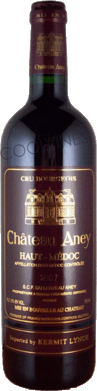
Tour de France: Cabernet Blend, Haut-Médoc, Château Aney, Bordeaux, France, 2009

This left-bank Château Aney is situated strategically between St-Julien and Margaux, at the epicenter of the great wines of the region where the terroir imparts exceptional quality and provides ideal growing conditions. The warm summer sun is tempered by the cool breezes of the Garonne, and round, polished, gravelly, river stones cover the vineyard.  The final blend of the wine matches the proportions in which they are planted throughout the seventy-four acres of vineyards: 65% Cabernet Sauvignon, 25% Merlot, 7% Cabernet Franc, and 3% Petit Verdot. This traditional Haut Médoc is more like what you might remember of the classic Bordeaux styles of the 1960s and 1970s. This wine is NOT at all cloaked in new wood or over-extracted tannins, Château Aney’s wines have finesse and balance!

  • SUCCULENT
  • Black Cherry
  • Plum
  • Blackberry
  • Dusty Black pepper
  • Tobacco Leaf
  • Subtle Earthy Finish

Château Aney was built in 1850 by the family that gave it its name, just five years before the wine classification system was initiated in Bordeaux, where the domaine earned "Cru Bourgeois" status.  By the mid-twentieth century the land was no longer being farmed and the Château had fallen into disrepair. Then in 1972 Jean Raimond and his son, Pierre, bought the property, rehabilitated the vineyards, and refurbished the winery and cellars bringing it back, more glorious than ever. This new era for Château Aney also achieved "Cru Bourgeois" status in 1978. Which we can read this as showing just how accurate this classification system is, or does it illustrate just how resistant to change the French wine community can be.  You should taste the wine and decide...


Thursday, July 25, 2013

Tour de France: Melon de Bourgogne, Muscadet de Sèvre et Maine, Sur Lie, DOMAINES VINET, "DOMAINE ST. MARTIN" Loire, France, 2011

DOMAINE ST. MARTIN was started in 1830 by a monk, located on the edge of the Maine river, less than twenty acres and on one lot, which is unusual in the Muscadet region. The harvest begins early September. The yields are not excessive (55 hl/ha) and all the fruit is harvested by hand.  Kept “sur lie” (on the lees; the yeast post fermentation)  for eight months before being bottled at the end of May, unlike most in this appellation who bottle in March.  This is a unique wine that everyone should try at least once, preferably on a hot summer day with some delicious fresh seafood.

  • RESILIENT
  • Lime
  • Tangerine
  • Chalk
  • White Almond
  • Refreshing

Please, do not become confused; other French wines are named for their appellation: Burgundy, Champagne, Cotes-du-Rhone, etc. Muscadet follows neither convention; Muscadet is the name of the wine, not the region nor the grape,  and the specific area name is added on; “ de Sevre et Maine,” reflecting their origin in the region around the Sevre and Maine rivers that flow into the Loire river.  This wine is made from the Melon de Bourgogne grape, considered a cousin of Chardonnay.

Wednesday, July 24, 2013

Tour de France: Viognier, CINQUANTE-CINQ, Vin de Pays d'Oc, Languedoc, France, 2012

The grape vine flourishes in the Mediterranean climate of Languedoc, with more acres planted to the vine than any other winegrowing region in the world!   Thirty miles southwest of Montpellier,  in Alignan du Vent, the producer of Cinquante Cinq is the largest family-owned and operated coop in France, with a long history of farming and managing the same family-owned vineyards.  Working with the microclimates created by the coastal Mediterranean influence, on sites with optimal exposure to the sun and its prevailing North wind, Aligan du Vent is home to a variety of soils, including siliceous gravel, middle terrace areas of clay and gravel, and lower terraces of sand.  Here Cinquante Cinq is making some stunning wines!
  • LUXURIOUS
  • White Peaches
  • Baked Apples
  • Citrus Oil 
  • White Flower Petals
  • Minerals
Made with 100% Viognier from fifteen year-old vines, using Sustainable Farming techniques; no chemicals, no synthetic treatments this is a delicious wine.  Only eight-hundred cases were made making this a wine that will be gone before we know it.  Thanks to the families and farmers that made this wine possible, it is truly remarkable. 


Saturday, July 20, 2013

Tour de France: Merlot / Cabernet Blend, Graves, CHÂTEAU CABANNIEUX, Bordeaux, France, 2009

Chateau Cabannieux is a very old family property. Mentioned in 1874 as “Première catégorie” winery and in 1881 classified as “Cru Exceptionnel” establishing a record of continuous improvement.  With almost 50 acres of vineyards, surrounding the Château, Hugo Dudignac, is producing red and white AOC Graves wines with distinction.
  • POWERFUL
  • Earthy
  • Black Cherry
  • Vanilla
  • Old Wood
  • Chocolate
  • Structure

The Chateau Cabannieux is on the top of a little hill, all the surrounding vineyard is planted on its slops. It gives the vineyard an ideal sun exposure as well as great natural water drainage.  The soil is mainly graveled with a subsoil made of gravel, from which comes the name of “Graves.”  With vines of: 50% Merlot, 45% Cabernet Sauvignon, 5% Cabernet Franc, not the traditional Cab dominate Graves.  However the winemaking is very traditional in cement vats for 4 to 6 months , and then in barrels of 18 to 24 months.  After bottling, the wines spend a year in the cellar before being sold.  It is delicious tonight, but if we had the patients to wait ten years or more it will become a wonderful wine.